
The Bottleneck of the AI Boom: Site Selection Factors for Data Center Development in Germany
How grid connection, water, planning law & the EnEfG shape data center site selection in Germany — the data-driven factors deciding where you can build.
Introduction: The AI Boom and the Infrastructure Divide
The rapid rise of artificial intelligence (AI) and ongoing digitalization are driving demand for computing power steeply upward. For developers and investors, the focus is shifting fundamentally: site selection for data centers is long past being a pure real estate question. It has become a highly complex optimization task at the intersection of energy infrastructure, planning law and environmental economics.
Geographically, the market today can be divided into two basic data center types, whose location requirements could hardly be more different.
- Real-time applications: Applications such as high-frequency trading, cloud banking or autonomous navigation systems tolerate no delay. Because of the physical limit of the speed of light in fiber-optic cable, these data centers must sit close to urban conurbations and major network hubs (latency optimization).
- AI model training (asynchronous workloads): The compute-intensive training of large language models (LLMs), by contrast, is not time-sensitive. This megawatt-scale infrastructure can be planned decoupled from urban centers — wherever the climate allows free cooling and consistently cheap, green energy is available, for example in Scandinavia (resource optimization).
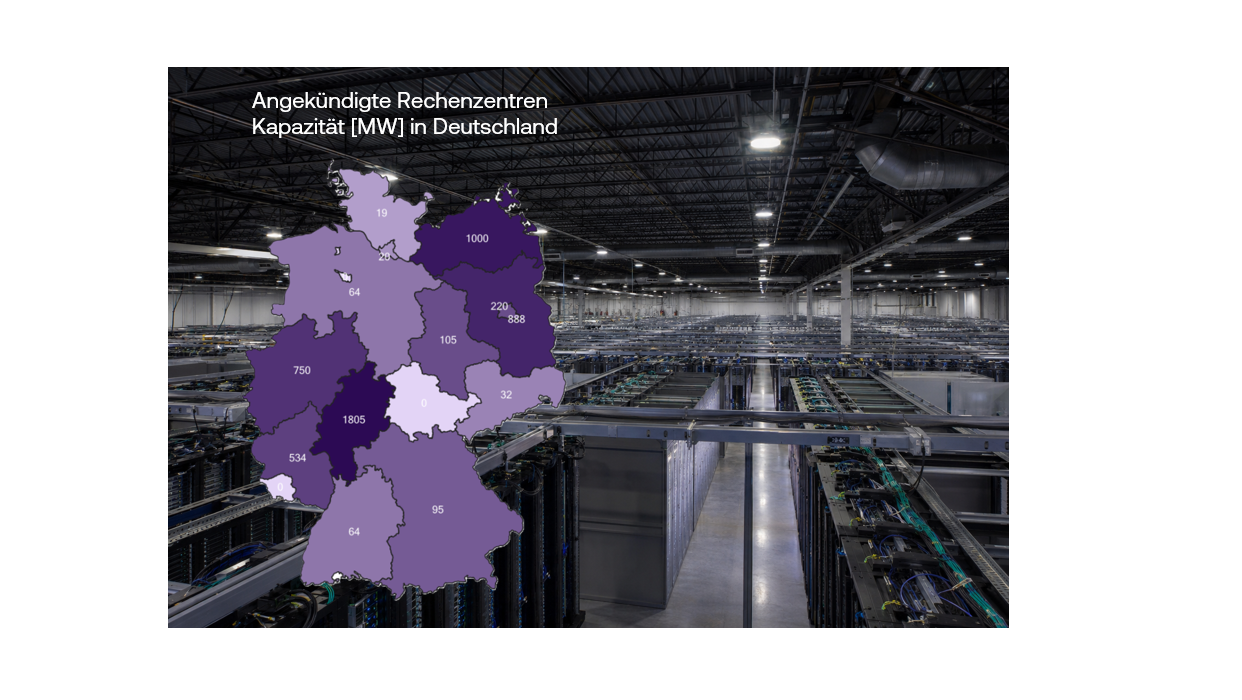
In Germany, it is above all the boom in real-time applications that is visible. The announced expansion projects alone add up to roughly 200% of the capacity already installed (Figure 1). Because of the latency advantage, this growth concentrates in the established conurbations of Hesse (the FLAP hub of Frankfurt), Bavaria, North Rhine-Westphalia and Berlin. This clustering brings two tangible problems with it: regional grids are reaching their physical limits, and land-use conflict with residential development, industry and nature conservation is intensifying.
.png)
The Key Site Selection Criteria for Data Centers
Anyone who wants to build a future-proof data center has to analyze a tight web of hard exclusion criteria and soft location factors. Six categories are decisive here.
1. Power Supply
Depending on their size, modern data centers require a continuous, high-availability power supply in the two- to three-digit megawatt range. In Germany, however, the classic route via a simple connection to the public electricity grid is increasingly becoming the limiting factor. Sluggish grid expansion and an ever-growing number of competing connection applicants — from decarbonizing heavy industry to large-scale battery storage — lead to long waiting times. In the Frankfurt area, operators now wait years for capacity; for one project by the operator EdgeConneX, for example, grid connection was confirmed for 2037 at the earliest.
Three strategic levers follow from this:
- Decentralized self-supply. To make projects feasible at all, developers increasingly plan a partially self-sufficient energy supply via on-site renewables, battery storage and hydrogen-ready gas power plants. This tends to make projects smaller in scale and pushes them further into the periphery.
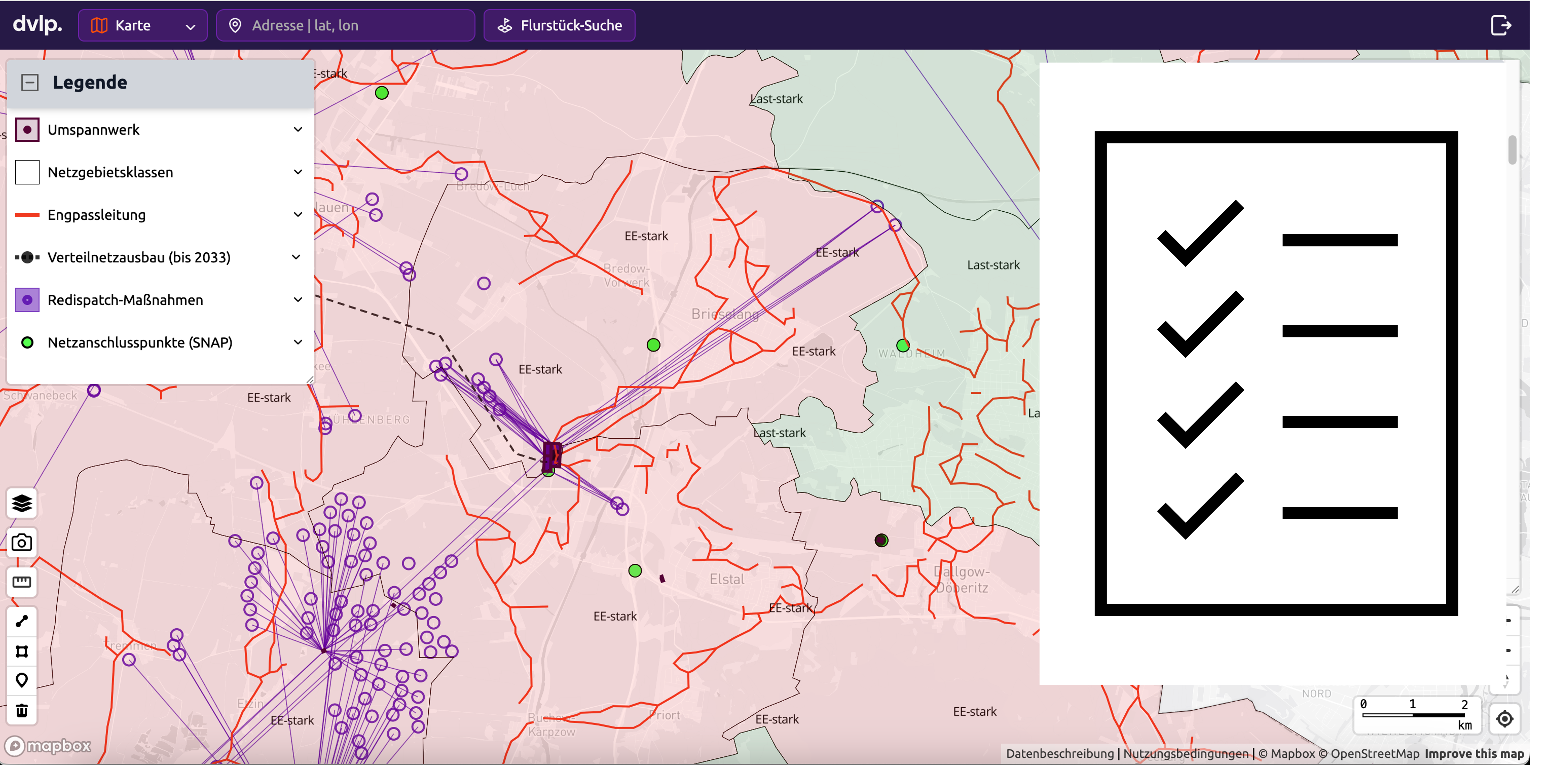
- Data-driven site analysis. In Germany, grid connection availability can be anticipated precisely. Grid congestion maps, redispatch data and the network development plans (NEP) of the transmission and distribution system operators show where a connection is realistic — and where drastic restrictions loom under the new grid package proposal. A map of capacity-limited grid areas makes this visible in exemplary fashion.
- Cable pooling & private infrastructure. To accelerate connection, the use of private connection infrastructure and the controlled overbuilding of existing connections is coming into focus: a data center and complementary generation (wind, PV) use the same grid infrastructure countercyclically. The real bottleneck here lies less in the concept than in the matching — it takes a partner whose feed-in profile, connection capacity and location fit the project. Who owns which connection infrastructure, and where, is barely discoverable through classic channels; only a dataset paired with an active developer network makes suitable counterparties visible and reachable — at dvlp.energy, for instance, through a network of thousands of registered projects.

2. Fiber-Optic Connectivity
Physical connection to the backbone network is an existential requirement. Because the civil engineering costs for new dark fiber routes are extremely high per kilometer, proximity to existing fiber routes is a primary economic viability factor. Independent of the cable itself, the value of a colocation site also rises with proximity to central peering points and internet exchanges such as DE-CIX in Frankfurt.

3. Water Supply
Modern high-performance computing (HPC) clusters generate immense thermal loads. Classic data centers cool via adiabatic evaporation — with enormous consumption: a 100 MW hyperscale data center requires around 2 billion liters of fresh water per year, roughly as much as the entire drinking water demand of a city the size of Passau. Owing to falling groundwater levels and looming usage conflicts, municipalities are increasingly refusing water rights. Closed cooling loops (direct-to-chip liquid cooling) are one answer, but they drive capital expenditure up significantly. Secured, sustainable access to industrially usable fresh water or treated greywater therefore remains a clear location advantage.
4. Planning Law
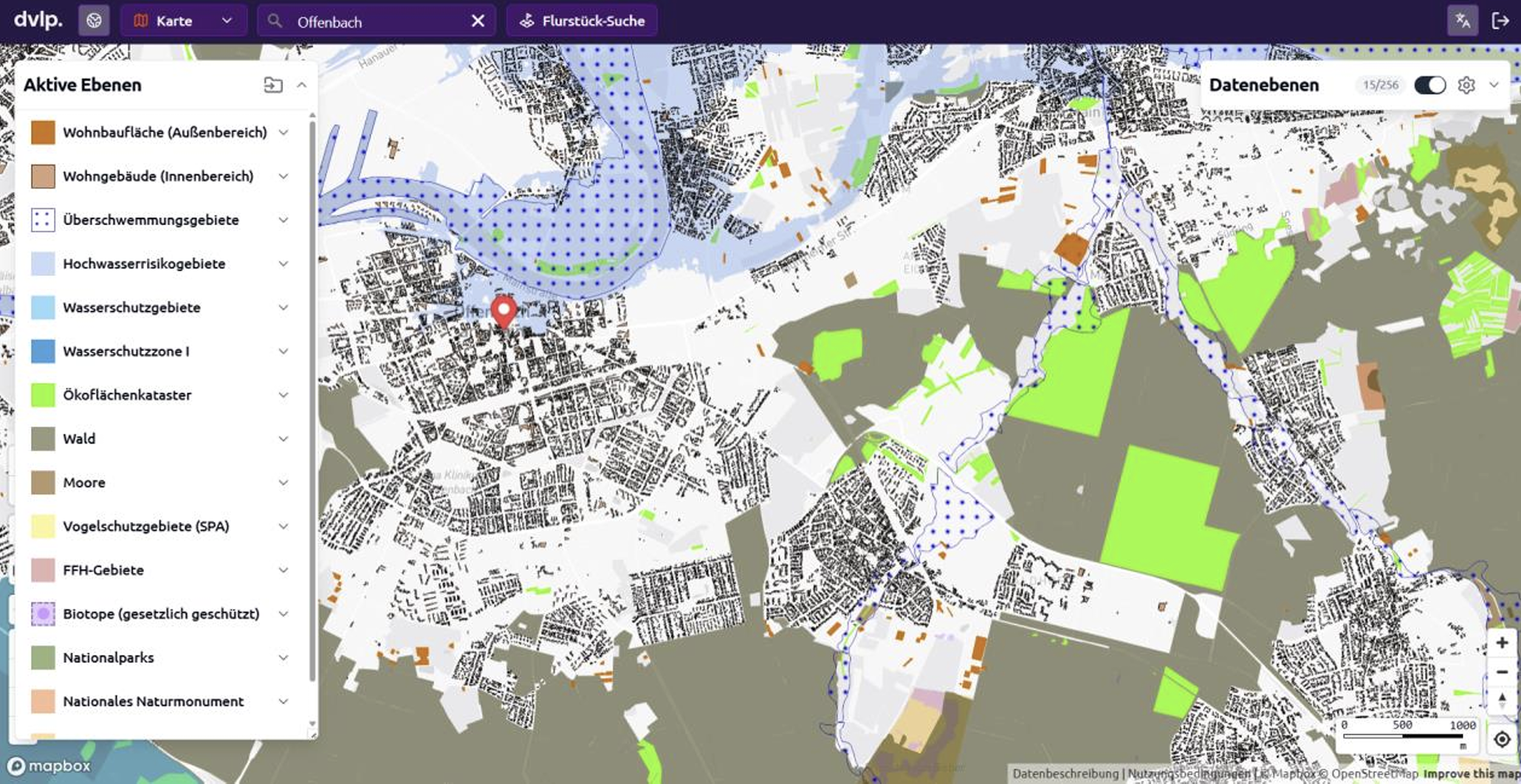
A data center needs building permits under building regulations, based on a valid development plan (Bebauungsplan, B-Plan). In practice, mere designation as a commercial zone (GE) or industrial zone (GI) is rarely sufficient: old development plans often fall short (e.g. height restrictions of 10–12 meters, while data centers often need 25 meters), or have site coverage ratios (GRZ) that are too low. The consequence is almost always a time- and cost-intensive project-specific development plan (§ 12 BauGB), in which all public interests must be weighed:
- Nature and landscape conservation (impact-compensation rule)
- Heritage protection and heritage buffer zones
- Water protection zones and the risk of surface flooding
- Noise emissions (in particular during periodic test operation of the massive diesel backup generators during nighttime hours)
- Firefighting water retention and fire protection concepts
- Higher-level spatial planning plans of the federal states
Without a clear political will on the part of the municipality, such a project fails. That cities are acting more restrictively is shown by the so-called "Lex Frankfurt" or the trend toward exclusionary development plans, intended to slow the displacement of classic mid-sized businesses (Mittelstand) by capital-rich data center developers.
5. The Energy Efficiency Act (EnEfG)
The EnEfG — the national implementation of the revised EU Energy Efficiency Directive (EED) — sets tight limits from a rated connection capacity of 300 kW upward. Two components shape site selection in particular:
- Waste heat utilization obligation (§ 11 EnEfG). By 2028, the mandatory share of energy to be dissipated and reused (Energy Reuse Factor) rises in stages to 20% (already 10% from July 2026). A data center on a greenfield site with no heat off-taker is thus effectively no longer permittable. Sites with direct access to an existing district heating network, to municipal heat network planning, or in the immediate vicinity of permanent large off-takers (such as hospitals, industrial processes or large greenhouses) have a clear advantage.
- 100% green power on a balance-sheet basis. From January 1, 2027, data centers must cover their energy demand entirely from renewable energy. On a balance-sheet basis this is solvable via certificates — yet, driven by the sustainability strategies of Google (24/7 carbon-free energy) and Microsoft, the market increasingly demands physical, time-matched availability. A local wind or solar farm in direct proximity, ideally secured via an on-site PPA, thus moves from "nice to have" to a central asset (Figure 5).

6. Business Continuity and Economic Viability
Alongside planning law and energy efficiency, insurability and economic viability impose their own requirements. For certifications under DIN EN 50600 or BSI Grundschutz (IT baseline protection), and for optimized property and business interruption policies from the major insurers (such as Swiss Re or Aon), hard environmental risks (accumulation risks) must be excluded — typically via defined minimum distances from:
- Hazardous-materials and chemical plants (explosions, corrosive gases in the air intake)
- Nuclear facilities and critical (KRITIS) infrastructure (sabotage and collateral damage risk)
- Airport approach paths (aircraft crash risk)
- Elevated particulate matter and soot pollution (wear on the sensitive air filtration systems)
- Geological risks such as designated seismic zones and flood risk areas (ZÜRS zones)
Added to this is adequate transport access for maintenance personnel and logistics.
Conclusion: Data-Driven Site Development as the Key
The days when a cheap plot in a commercial zone with a nearby medium-voltage cable was enough for a data center are over. Site selection in Germany is today an interdisciplinary task. Anyone who wants to secure and develop land must analyze grid capacities, municipal heat feed-in potential, water rights and planning-law exclusion criteria simultaneously and on a data-driven basis. Making precisely these data layers transparent early — from the grid congestion map to land-use conflict — thus becomes the decisive tool for the infrastructure of tomorrow.
Are you developing sites for data centers, or the matching generation alongside them? At dvlp.energy we bring the data layers mentioned here — capacity-limited grid areas, grid expansion, land-use and planning-law conflicts — together on a single map, and help broker connections to local partners. Feel free to take a look, or get in touch if you'd like to think through a concrete project.
More blog posts

Request a demo now

